dev-team
Two ways to run it
Section titled “Two ways to run it”The roles and their documents are the same either way; only where they run changes.
| Default | Orca runtime | |
|---|---|---|
| Where roles run | in your Claude Code conversation, one at a time | each in its own Claude Code session, several at once |
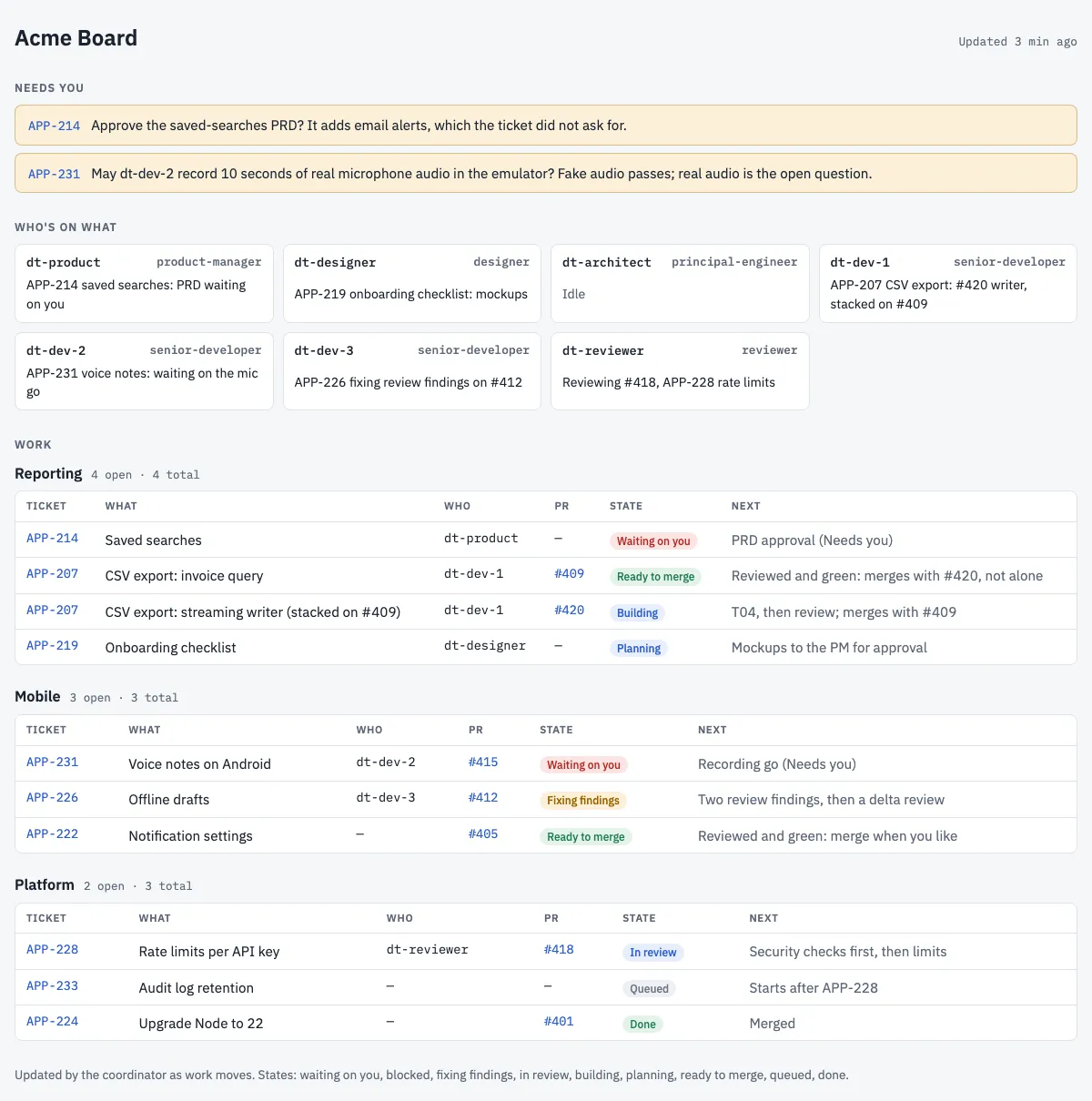
| Your session | works through each phase with you | coordinates: hands out tasks, answers the peers’ questions, takes your approvals |
| Parallel work | a subagent for each independent stream, only when it pays | developers building at once, each in their own worktree |
| Token use | low: most work never starts an agent | higher: every task starts a fresh session (about 35k tokens, mostly your project’s own context) |
| While you’re away | waits for you | check-ins keep work moving on a schedule |
| Needs | Claude Code | Claude Code run from Orca, and /dev-team:orca |
Not using Orca? The default is all you need. Using it? The recommended setup configures a full team in one step.
How a feature moves
Section titled “How a feature moves”You bring a request. The orchestrator routes it, and each role hands the next one a document.
| Role | Writes | Who signs it off |
|---|---|---|
| product-manager | a brief, or a PRD for bigger work | you, for a PRD or a change of scope |
| designer (UI work only) | a design spec and mockups | the product-manager |
| principal-engineer | a plan, ADRs, and a task list | itself, unless it contains a major decision |
| senior-developer | code and tests, one task at a time | (every task done) |
| reviewer | a review against the acceptance criteria | you approve the release |
Bugs and chores skip all of that and go straight to a developer. Pipeline explains how the team sizes the process to the work.
Why it works this way
Section titled “Why it works this way”Nothing lives only in a chat: every decision is written to the workspace, so the next role, or next week’s session, starts from the file. Every role checks its work against those documents before handing off.
You choose how much you’re asked, from every step to only what’s irreversible, risky or costly, and whether the team starts new work on its own (Autonomy).
Optional extras
Section titled “Optional extras”